
CONSEF JUDGES
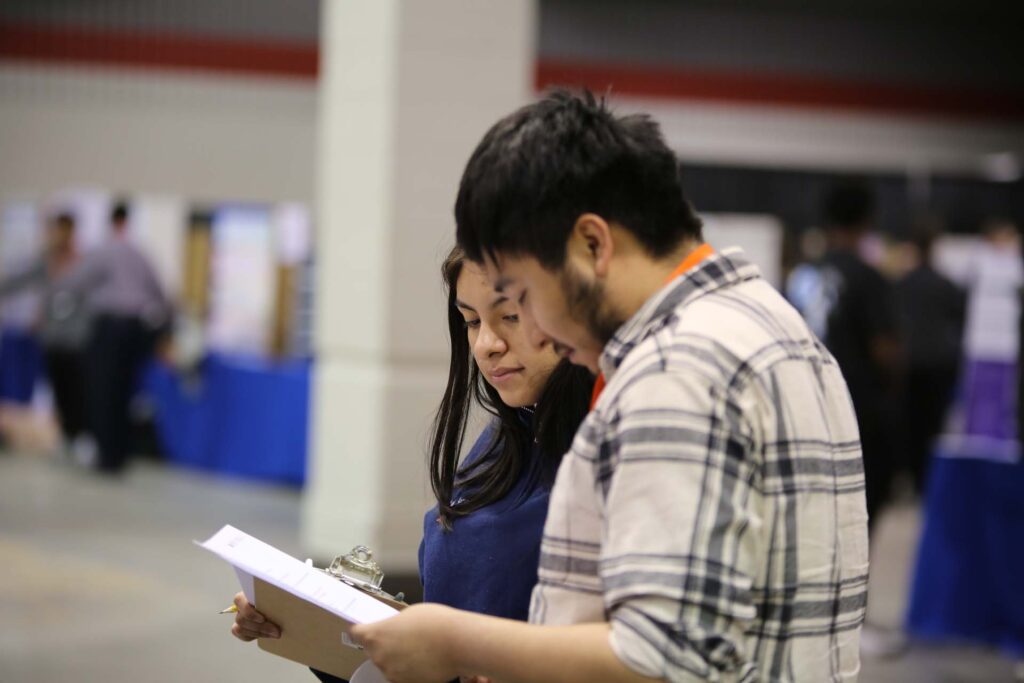
By volunteering at STEMCON events, you become part of a meaningful mission to help build a brighter and more innovative future.
At the CONSEF Poster Session, nearly 200 dedicated judges come together each year to evaluate outstanding student projects. Beyond scoring, judges play a vital role in mentoring young innovators by sharing their valuable knowledge, professional insights, and real-world experience.
We sincerely appreciate your interest and willingness to contribute your time and expertise. Your participation makes a lasting impact on students and strengthens our STEM community.
Please review the information below to learn more about serving as a CONSEF judge, and click the judge application link to complete your registration.
Judges Information
Venue
Judges' Information
Judging is, without a doubt, one of the most important phases of any science fair. Because of its extreme importance, all judges should carefully review the following:
Science Fair Judging Guidelines
Judging Rubrics
JUDGING CRITERIA – EXPERIMENTAL PROJECTS
The following is the criteria for the Concept Science & Engineering Fair judging procedure. THE DECISION OF THE JUDGES IS FINAL. There are four parts (Overall Impression of the Project, Display, Oral Presentation, Written Report) being examined during the judging procedure. Participants are expected to get the maximum available points from each criterion.
OVERALL IMPRESSION OF THE PROJECT
- Scientific Approach : ( max-8 pts) – Well defined problem was solved using scientific principles.
- Knowledge Gained : ( max-10 pts)- Student has understood the topic, mastered the scientific skills, and answered all questions correctly.
- Experimental Approach: (max-10 pts)- Dependent and independent variables were defined and control group was in evidence.
- Reliability of Data : ( max-8 pts) – Data is numerical and metric. Data is reliable with repeated trials.
- Validity of Conclusion : ( max-5 pts) – Conclusion is consistent with the data provided.
- Originality : ( max-10 pts) – Topic is original and method is highly creative.
DISPLAY
- Information : ( max-7 pts) – Display gives complete explanation with graphs, charts and pictures.
- Technical Requirements : ( max-4 pts) -Safety and endorsement sheets are displayed.
- Artistic Qualities : ( max-5 pts) -Backboard is neat, organized, and appealing. No spelling errors.
ORAL PRESENTATION
- Presentation Quality : ( max-10 pts) – Clear presentation which is easy to follow. Information is relevant.
- Dynamics : ( max-10 pts) – Speaks fluently with good eye contact, polite, dynamic, and interested in his/her subject. Not relied heavily on note cards or the board.
WRITTEN REPORT
- Order : ( max-5 pts) -Report is neat and in logical order (Title, content, acknowledgements, problem, hypothesis, review of literature, materials, procedure, results, conclusion, reference list).
- Spelling/Grammar : ( max-3 pts) -No spelling or grammatical error is present.
- Review of Literature/Reference List : ( max-5 pts) -Quality, quantity, and variety of sources is adequate for topic.
JUDGING CRITERIA – DESIGN PROJECTS
OVERALL IMPRESSION OF THE DESIGN PROCESS
- Design Approach Overall: (max-8 pts) – Has identified a need or real world problem.
- Knowledge Gained : (max-10 pts) -Exhibits a thorough understanding and the application of the design Student has acquired design skills.
- Design Approach-Performance Criteria: (max-10 pts) -Clear performance criteria have been developed to address the features of the product, algorithm, proof, model, etc.
- Constructing and Testing the Prototype: (max-8 pts) -Has constructed and tested a prototype. Data analysis/validation is evident.
- Validity of Evaluation/Conclusion : (max-5 pts) -Conclusion accurately reports with the success/failure of the design.
- Originality : ( max-10 pts) – Topic is original and method is highly creative.
DISPLAY
- Information : ( max-7 pts) – Display gives complete explanation with graphs, charts and pictures.
- Technical Requirements : ( max-4 pts) -Safety and endorsement sheets are displayed.
- Artistic Qualities : ( max-5 pts) -Backboard is neat, organized, and appealing. No spelling errors.
ORAL PRESENTATION
- Presentation Quality : ( max-10 pts) – Clear presentation which is easy to follow. Information is relevant.
- Dynamics : ( max-10 pts) – Speaks fluently with good eye contact, polite, dynamic, and interested in his/her subject. Not relied heavily on note cards or the board.
WRITTEN REPORT
- Order : ( max-5 pts) -Report is neat and in logical order (Title, content, acknowledgements, problem, hypothesis, review of literature, materials, procedure, results, conclusion, reference list).
- Spelling/Grammar : ( max-3 pts) -No spelling or grammatical error is present.
- Review of Literature/Reference List : ( max-5 pts) -Quality, quantity, and variety of sources is adequate for topic
Awards :
GOLD: 91-100
SILVER: 81-90
BRONZE: 71-80
HONORABLE MENTION: 70 OR LESS